
Guide
Buying an above-ground pool: the complete guide
Quick-up, frame or steel-wall? Round or rectangular? And what do you need besides the pool itself? This guide takes you step by step to the right pool for your garden.
Updated 7 min readEditorial team wopool.de
Step 1: How do you want to use the pool?
Before comparing models, take an honest look at how you'll use it. Is the pool mainly meant to cool the children down on hot days? Then a small to medium pool 76 to 84 cm high is enough. If you want to swim as an adult too, or really cool off, a depth of 100 to 132 cm and a length of at least 4 m make sense. And how long should the pool stay up: one summer, a few months every year or permanently?
The answers almost automatically point to the right type of pool. If you want to stay flexible, choose a quick-up or frame pool. If you have a permanent spot in the garden and want to use the pool for many years, a steel-wall pool is a good choice.
Step 2: Choose the right type of pool
Quick-up pools are the cheapest way in. An inflatable ring holds the top edge, and the water raises the wall. They are quick to set up but not particularly rigid. Frame pools stand on a steel-tube frame; they are sturdier, available in many shapes and still easy to assemble without many tools. Steel-wall pools have a solid wall of coated steel and an inner liner. They last the longest and, depending on the model, can be partly or fully sunk into the ground.
- Quick-up: setup in about an hour, ideal for trying things out
- Frame: sturdy all-rounder, usually one to three hours to set up
- Steel-wall: long-lasting, more involved setup, often stays up all year
Popular frame pools
Ad All products linked with "View offer" are commission (affiliate) links: if you buy through them, we earn a commission – the price stays the same for you. As an Amazon Associate and eBay Partner Network affiliate we earn from qualifying purchases. Learn more
 Ad
AdVEVOR Frame Pool Aufstellpool Stahlrahmen Schwimmbecken 3000x2000x762mm …
 Ad
AdAvenli Pool 258 x 179 x 66 cm steel frame above-ground pool without pump …
 Ad
AdIntex Frame Pool 300x200x75cm Above-Ground Pool Rectangular Steel Frame …
 Ad
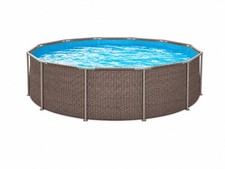
AdFrame pool swimming pool 305x76cm pool steel tube pool RATTAN
Step 3: Size and location
Measure the available space and allow at least half a metre to a metre all round for the ladder, pump and maintenance. The ideal spot is sunny, sheltered from wind, not directly under trees and within reach of a tap and an outdoor socket protected by a residual current device (RCD). Keep the pump at the distance from the pool specified by the manufacturer.
Don't underestimate the weight: a pool 3.66 m across and 76 cm high holds around 6,500 litres, a large rectangular pool easily 15,000 litres or more. An above-ground pool is therefore generally out of the question on roof terraces and balconies – unless a structural engineer has confirmed the load-bearing capacity.
Step 4: Prepare the ground
Level, load-bearing ground is the most important requirement for a long-lasting pool. Remove the turf, stones and roots, compact the soil and screed it perfectly level with a straightedge and spirit level. A thin layer of sand makes levelling easier. On top goes a protective ground fleece or mats that keep out sharp pebbles and protect the liner. For frame pools, ideally stand the legs on paving slabs so they don't sink in.
Don't just put the pool on the lawn: it's rarely level, gives way under the load, and the grass underneath dies and can go mouldy.
Step 5: Filter, care and accessories
From about 2,000 litres you need a filter pump. Small pools manage with cartridge filters, larger pools with sand filters. The pump should be able to circulate all the water once in about four to six hours. On top of that come water care products with test strips, a skimmer net, a floor vacuum or pool robot, a ladder and a cover.
- Filter pump or sand filter matched to the volume
- Test strips, pH adjustment and disinfection
- Skimmer net and floor vacuum or pool robot
- Safety ladder with removable steps
- Pool cover or solar cover
Complete pool sets with filter pump
Ad All products linked with "View offer" are commission (affiliate) links: if you buy through them, we earn a commission – the price stays the same for you. As an Amazon Associate and eBay Partner Network affiliate we earn from qualifying purchases. Learn more
 Ad
AdBestway Fast Set above-ground pool set complete set Ø 457 x 107 cm round
 Ad
AdPool Quick Up 396 x 84 cm Set Gartenpool Aufstellpool Schwimmbad grau mit …
 Ad
AdIntex Frame Pool Set Prism Rondo Ø 366x76 cm with Pump Above-Ground Pool …
 Ad
AdPool Komplettset Gartenpool Aufstellpool Frame Schwimmbad blau rund Pumpe …
Step 6: Permits and neighbours
In Germany, whether you need a permit for a pool is governed by the building codes of the federal states. In many states, pools up to a certain volume – often 100 cubic metres – are exempt from permits, at least outside undeveloped outlying areas. Typical above-ground pools are well below that. Roofs, enclosures or pools right on the property boundary may, however, be assessed differently. If in doubt, ask your local building authority. Being considerate towards your neighbours also pays off: try not to put the pump right on the boundary, and don't run it at night if it can be heard.
Step 7: Estimate running costs realistically
On top of the purchase price come water, electricity for the pump, care products and wear parts. Filling costs a modest amount depending on your municipality and the volume; ask your water supplier whether pool water is exempt from wastewater charges – some German municipalities offer this. The pump runs for several hours a day during the season, and a heater or heat pump increases electricity consumption considerably. A cover saves the most here, because it reduces heat loss, evaporation and dirt.
Safety for children
A garden pool is a serious hazard for young children. Drowning happens quickly and usually silently. Never leave children unsupervised at the pool, remove or fold up the ladder after swimming and cover the pool. If there are toddlers in the household, a fence is a good idea. Armbands and swimming aids are no substitute for supervision.
The best time to buy
Pools are seasonal goods. In late spring demand rises – and often prices with it – while in late summer and autumn remaining stock and last year's models get cheaper. If you can plan ahead, watch the price history of the model you want and buy outside peak season. That way you'll have everything ready next spring as soon as temperatures rise.
Steel-wall pools for years of use
Ad All products linked with "View offer" are commission (affiliate) links: if you buy through them, we earn a commission – the price stays the same for you. As an Amazon Associate and eBay Partner Network affiliate we earn from qualifying purchases. Learn more
 Ad
AdStahlwandpool Set Leiter 2,40 x 0,9 Rund Rundbecken Aufstellbecken Rundpool
 Ad
AdPool Stahlwandpool Swimmingpool 3,60 m x 0,90 m Leiter Poolfolie …
 Ad
AdStahlwandpool Pool 2,4 m x 0,9 m Leiter Poolfolie Swimmingpool …
 Ad
AdPool Stahlwandpool 3,60 x 0,90 m blau weiß Skimmer Leiter Folie …
Setup step by step
Once you've prepared the ground, the actual setup is usually quicker than expected. Spread out the ground fleece, lay the pool liner in the middle and turn the skimmer and pump connections towards the side where the pump will stand. With frame pools, first push the crossbars through the sleeves, then add the vertical legs. With steel-wall pools, lay out the bottom rail first, then stand the steel wall in it and bolt it together before hanging the liner.
Let in just a few centimetres of water at first and smooth out any wrinkles in the floor from inside. Only continue filling once the floor is wrinkle-free. Check several times while filling that the pool is standing straight – later, the only way to correct it is to drain the water again.
Checklist before you buy
These questions will quickly show you which offer suits you:
- How much space do I have, including room for the ladder and pump?
- How deep should the pool be – for children or for swimming?
- Will the pool be taken down and set up every year, or stay up?
- Is a suitable filter pump included, and is it powerful enough?
- Are replacement liners, seals and accessories available for the model?
- Do I have water and a power supply with an RCD nearby?
Good to know: pools and power supply
Pumps and heaters belong on an outdoor socket with a residual current device (RCD). Extension cables and multi-socket adapters outdoors are not a permanent solution.
Conclusion
The right above-ground pool comes down to use, space and budget: quick-up for trying things out, frame as a flexible all-rounder, steel-wall for many years. Invest time in level ground and a sufficiently powerful filter – these are the two things that decide whether your pool brings joy or trouble. And buy outside peak season if you can; you'll get more pool for your money.
FAQ
Which above-ground pool is the most stable?
Steel-wall pools are the most stable and longest-lasting, followed by frame pools. Quick-up pools are the least rigid.
How deep should a pool for adults be?
For swimming and really cooling off, 100 to 132 cm is comfortable. For younger children, 76 to 90 cm is safer.
Do I need planning permission for an above-ground pool?
Usually not. Many German state building codes exempt pools up to a certain volume, often 100 cubic metres, from permits. If in doubt, ask your local building authority.
Can I set up a pool on the patio?
On level, load-bearing ground, yes; on balconies and roof terraces generally not, because the load quickly amounts to several tonnes.